

data:
28.03-30.08.2026
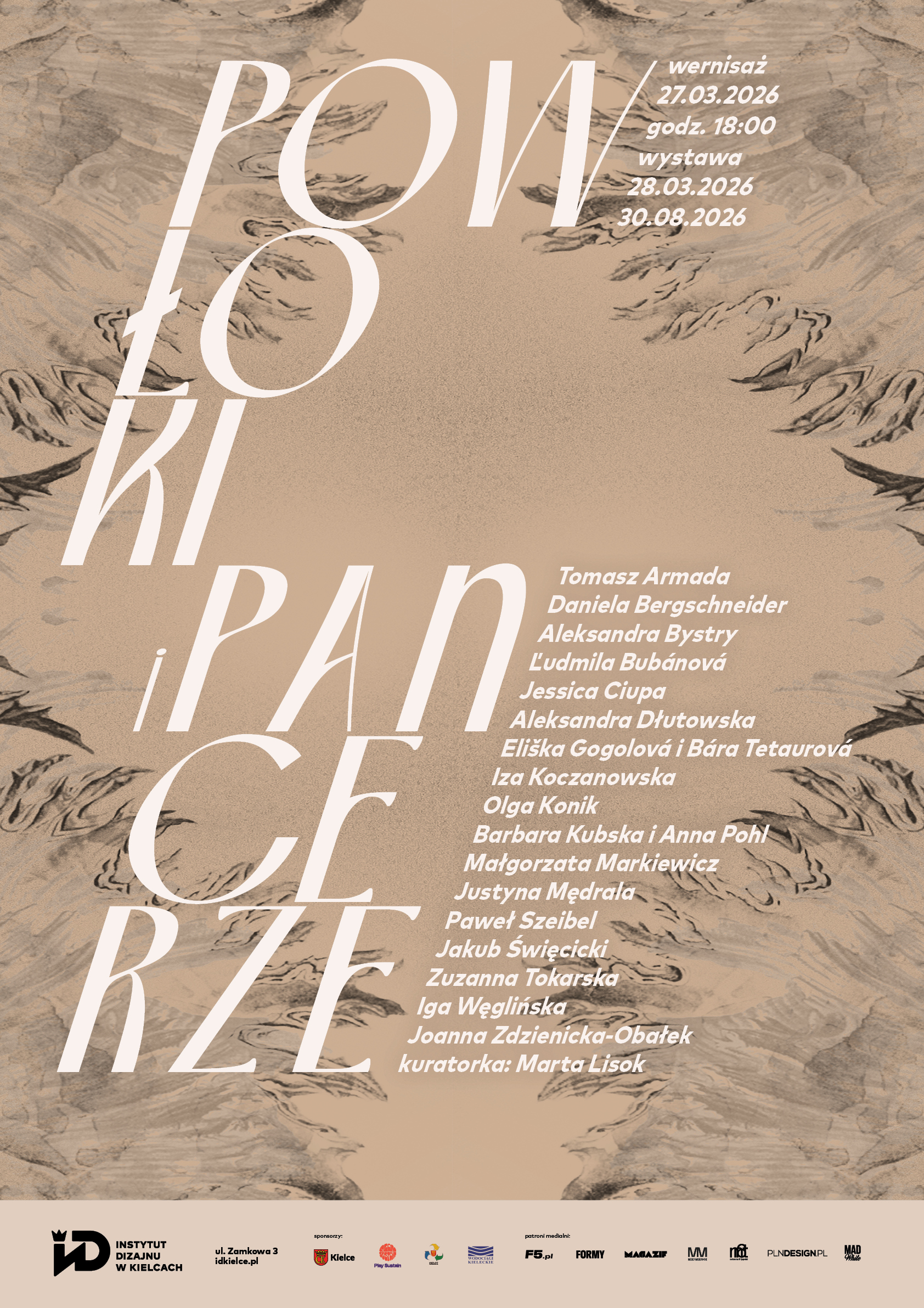
The Coverings and Carapaces project proposes the creation of a costume-prosthesis capable of expanding the user’s sensorium. The collaborative research, conducted across art, design, botany, narratology, and bioengineering, seeks to move beyond the limits of human perception. Regardless of whether recycled textiles, biomaterials, or traditional weaving techniques are employed, the shared denominator of these practices is the construction of narratives through layers. These layers can be soft, elastic, and slick, but also flaking, rigid, and hardened. Tracing the dynamics of the materials that compose them recalls the examination of a body’s surface poised for moulting. Passing through the stage of shedding an ill-fitting, overly tight skin, it begins to search for a more accommodating form – adapting to shifting environmental conditions and the challenges and threats inscribed within them.
The investigations conducted within the project focus on shell-like membranes responsive to non-visual signals such as vibrations, temperature fluctuations, or olfactory stimuli. They draw, among other sources, on the communication systems of insects, the thermal dynamics of reptiles, and the regenerative mechanisms found in algae and fungi. They enable the wearer to inhabit unfamiliar bodies and to perceive according to different principles. In doing so, they prompt questions about the role of senses that humans have not yet evolved.
During the prototyping phase, a range of garments emerges: shelter suits, suits designed for composting, garments that increase humidity, additional repositories of memory, external archives of emotion, outfits for gatherers and nomads, womb-suits, and grave-suits. These coverings function as tools of transformation. By extending our cognitive capacities, they mediate between the body and the external world. They open up new modes of interacting with the environment and support speculation on future forms of interspecies cooperation, in which the use of carapace-objects merging with the body deepens social capacities. They enable faster, non-verbal communication and can trigger a wide spectrum of responses: from the urge to care for or protect, to flight or hyper-alertness, to stillness, regeneration, following another’s trace, or assembling a collective.
Curator: Marta Lisok
1. Justyna Mędrala
To Melt, To Bathe, To Dry, To Bind, 2026
The artist examines deposits of raw materials as an archive of past life–matter that has been transformed under pressure and high temperatures. In her practice, she frequently works with asphalt, exploring its physical properties. Used as a primary component in road construction, it stands as both a marker of civilisational progress and a sign of an unrestrained drive to exploit the landscape.
2. Daniela Bergschneider
Flex, 2026
Untitled, 2026
The artist combines porcelain with fabric. The objects she creates evoke ambivalent responses – they invite touch while provoking discomfort through associations with tendons and bones that seem to function independently of the body. The nylon surface that binds the porcelain structures appears stretched to the limit of its endurance, as if it might give way at any moment. By exploring the properties of the materials she employs, the artist engages with the potential for movement that remains suspended, waiting to be enacted.
3. Iga Węglińska
Frisson, 2025
Iga Węglińska explores fashion design at the intersection of the body and technology. She treats the garment as a form of prosthesis, extending the capabilities of the senses. For her, clothing is a tool of transformation, enabling not only enhanced perception but also the creation of new ways to interact with the environment. It expands human cognitive capacities beyond the biological limitations of the body, mediating between the wearer and the external world. Through the use of technology, it can amplify or suppress perceptual stimuli.
The title, Frisson, refers to a sudden, pleasurable physical sensation—such as goosebumps, tingling at the nape of the neck, or shivers running down the spine. This physiological reaction to intense stimuli is considered an atavism, a dormant survival instinct through which the body responds to sudden sounds as though they were threats. By raising the hair, it attempts to ward off potential danger.
4. Izabela Koczanowska
Ugly beach, 2025
The Great Tourist_01, 2025-2026
The Great Tourist_03, 2025-2026
The Great Tourist_04, 2025-2026
The Great Tourist_05, 2025-2026
Human Being Session, 2019
Objects designed by Izabela Koczanowska are inspired by the variable properties of biomaterials, including agar derived from marine algae. Based on these materials, the artist creates environments that evoke unstable, tourist-exploited coastlines. Their delicate membranes—slippery, translucent forms—recall sea foam and traces of intensive landscape use. They reveal themselves as remnants of a transformative process in which the “landscape-scenography” exposes its hidden ecological cost.
The video Human Being Session takes the form of a therapeutic experience, combining haptic, auditory, and visual stimuli. The artist guides participants into a hypnotic state, allowing work at the level of the subconscious and increasing receptivity to suggestion. In a soothing whisper, she conjures a vision of expanded species capacities, aiming to maximise human comfort and efficiency. This metamorphosis would occur through the release of dormant emotional potentials, such as empathy and compassion, that often act as inhibitors.
5. Jessica Ciupa
Untitled, 2025
Jessica Ciupa conducts interdisciplinary research on plant-based materials for the production of biodegradable yet durable clothing. Her work aligns with the rapidly developing field of biodesign, understood as a medium of speculation and critique of contemporary conditions. It emerges from the urgent need to develop alternative solutions to global overproduction and the improper disposal of plastics.
She has gained laboratory experience in the extraction and processing of algal biomass while working on the development of a bio-based textile derived from Gelidium corneum. This material is characterized by a high content of polysaccharides (agar) and bioactive compounds such as mycosporine-like amino acids (MAAs), which provide natural protection against UV-A and UV-B radiation. The material prototype also demonstrates antioxidant and anti-inflammatory properties, as well as the ability to retain moisture over extended periods, supporting skin regeneration and protection.
6. Joanna Zdzienicka – Obałek
Trashcatcher, 2026
The point of departure for Joanna Zdzienicka’s strategy is the collection of objects abandoned in ruderal landscapes, treated not as waste but as material traces of interspecies relationships.
The nets used in the installation are not merely display tools—they are part of the artist’s field research equipment, which she takes on exploratory walks. In her fieldwork, a net spread out on the ground serves to systematically collect samples and analyze what lies within the designated area.
It accompanies her in the field as a functional part of her work attire—folded, rolled, and secured with a strap, carried over the shoulder like a bag. Its mobility emphasises the procedural nature of her practice: the net is not a fixed object but an active cognitive tool, transforming from a utilitarian item, to a research instrument, and finally into an element of the installation, carrying with it traces of movement performed during walks and collection.
7. Paweł Szeibel
Resistencia, 2026
The installation is the artist’s personal interpretation of the Galician shepherd’s attire, originally designed to protect against rain and wind. It is made from natural materials such as broadleaf cattail (Typha latifolia L.) and rush (Juncus L.), plants typical of wetland areas, harvested by the artist from the surrounding environment. These materials are notable for their high resistance to moisture and, once dried, retain both lightness and flexibility. The long, pliable stems have been handwoven into a dense, compact structure using traditional craft techniques. Thanks to its construction, the piece functions as a mobile shelter that can be worn on the body.
8. Barbara Kubska and Anna Pohl
Secret Language, 2026
Spinning is not merely a production technique but also a method of attunement—to the rhythm of the body, to time, and to the material itself; it becomes an active participant in the transformation: softening, breaking down, and taking on new forms. Producing yarn from pine needles activates additional, long-forgotten modes of perception. The very act of gathering the material—collecting needles shed by the tree—grounds one to the earth, slows the body, encourages slower breathing, and guides the mind to follow the hands. Forest wool is made from boiled needles. During the scrubbing process, their hard outer layer and soft interior are gradually worn away, revealing thin, resilient fibres. Then, combed with hackles and blended with linen, they form a light material ready for spinning.
9. Ľudmila Bubánová
Anatomical Venus, 2025
The title of the work refers to medical models revealing the interior of the body; the objects are made of wood or wax, on which eighteenth-century physicians studied anatomy. Inspired by these fetishist representations of sleeping women, who helplessly expose their inner organs, Ľudmila Bubánová’s garments are made from yarn coated in latex.
The objects she creates imitate internal landscapes of tendons and muscles. They resemble armour or chainmail. As empty shells, they evoke a narrative of an absent wearer who has freed herself from them.
10. Aleksandra Dłutowska
Made in Poland, 2025
The designer works with found materials. Her collections draw on traditional decorative techniques and construction solutions typical of historical garments. Her clothing is made from folk textiles, pasiak (Polish folk striped fabric), two-ply fabrics from the Podlasie region, and contemporary knitwear sourced from the second-hand market. By using materials that carry stories, she reflects on the need to build a relationship with the past and to seek a sense of rootedness. At the same time, by deconstructing these materials, her collections transcend binary gender divisions and the social codes of duties and functions embedded within them.
11. Małgorzata Markiewicz
Connected, 2009-2026
The work explores the relationship between mother and child. It materialises the connection of two bodies, which seemingly ends at the moment when the umbilical cord is cut. The mother’s unpicked dress shrinks slightly each year, while the dress intended for the daughter grows proportionally. The installation is accompanied by a photographic record, with one photograph created each year to document the changing proportions of the two dresses. The process of altering their shapes serves as a record of the passage of time, measured by the rhythm of the transforming body.
12. Zuzanna Tokarska
Realisation by: Magdalena Tokarska
Untitled, 2026
As part of the Odpodszewki project, Zuzanna Tokarska offers a way to reuse unwanted bedding. She is particularly interested in fabrics printed with characters from popular cartoons and fairy tales.
Wearing dresses made from these materials takes on the character of a spiritual séance. It becomes a form of memory training. The garments function as tools for working with personal histories, enabling a return to childhood. They initiate an experience of collective dreaming, in which favourite cartoon characters reappear. However, the cut of the dress, its seams, and the wearer’s body reshape the characters, pulling them away from their original context. Their ghostly presence highlights the difficulty of accessing long-unvisited emotions and memories.
13. Olga Konik
Altre fibre, 2026
The artist prepares yarn from human and animal hair. She uses it to play a game known as the cat’s cradle, which involves weaving and complicating the arrangement of strings wound around the fingers. In doing so, she evokes hand choreographies whose movement embodies reciprocity and recurring gestures of care and attention. The work calls forth memories of tender touch, soothing combing, and gentle stroking.
14. Jakub Święcicki
Heard Stories, 2026
The shimmering curtain is made of handwoven magnetic tape, treated as a sculptural material. The work takes the form of a generational archive, built from the private collections of the artist together with those of his friends and family. The tapes bear traces of everyday listening and recording practices: music compilations recorded from radio broadcasts, foreign-language phrasebooks, as well as conversations between the artist and his sisters, recorded with a microphone during childhood play. By juxtaposing individual tapes, the artist evokes the rituals surrounding the circulation of cassettes—their borrowing, copying, and shared listening. Designed as a reflective surface of magnetic tape, the piece constitutes an archive of sounds, access to which is withheld by the artist. This arrangement prevents engagement with the voices recorded within it.
15. Eliška Gogolová and Bára Tetaurová
Nourish your body and soil, 2025
The cover, designed by the artist, invites the wearer to assume a lying position. The suit envelops the body like a shroud; in contrast to the paradigm of instantaneous and precisely planned actions aimed at maximum productivity, it connects the person to the matter of the earth and to the slow transformations taking place within. Embedded in the garment as a resting place, the consent to remain still—to be inactive—allows for immersion in one’s own body and surrender to the force of gravity. It funct
16. Aleksandra Bystry
Untitled, 2025
Aleksandra Bystry is engaged in disseminating knowledge about historical colour-making techniques. She is particularly interested in dye plants, which enable natural dyeing practices that have been almost entirely displaced by industrial processes. Her work with dyes resembles alchemical experimentation—testing the properties of materials, working with pigments, and tracing networks of relations between substances circulating in nature.
17. Tomasz Armanda
Sepulchral Gown from the Armageddon series
Tomasz Armada’s garments function as performative tools, enabling the testing of dormant identities and the exploration of potential ways to transcend them. Wearing them becomes an exercise in storytelling through fabric.
The costume Sepulchral Gown was created based on the deconstruction of the dress understood as a garment designed to conceal flaws and enhance the figure. Armada reverses this principle, directing attention instead to the inevitable fate of every body. Hand-dyed in shades of ochre, rust, ash, pink, and green, the dress evokes the cycle of matter, appearing as if removed from a grave. Stains on its surface recall the discolorations caused by contact with the earth, resulting from processes of decomposition.